Restoring Regulation in the Workplace: Aromatherapy, Nervous System Support
by Sheila Tucker, RN
I would like to begin this article with a personal story that explains why aromatherapy has become an integral part of my life and professional practice. As a registered nurse, I have witnessed firsthand the physical and emotional demands people carry, often quietly. My experiences at the bedside shaped my understanding of care beyond clinical treatment and led me to embrace aromatherapy as a supportive, human-centered approach to well-being—one I now hope you will feel encouraged to explore for yourself.

Sheila Tucker
A few days ago, I underwent a medical procedure that was fairly terrifying and involved multiple injections. As I waited for the procedure to begin I felt my body begin to shift. My heart rate quickened. Heat rose into my face and neck. My jaw tightened, shoulders stiffened, and my breathing became shallow and guarded.
These sensations were familiar. I recognized them immediately from when working with patients. They are not responses paired with weakness or anxiety, but with the nervous system moving into a fear response.
I wondered whether I could gently shift my internal state — not by forcing calm, but by offering my body a different sensory input. I immediately knew what to do. I reached in my purse and my hand landed on the forest bathing blend, an essential oil that I have nearby at all times.
I applied the rollerball of forest bathing blend slowly and deliberately to several points — my wrists, throat, heart space, lower back, behind my knees, and around my ankles — and then settled into slow, intentional breathing. There was a lightness in the moment, even a sense of appreciation. As the aroma began to register, another shift followed. The scent evoked something deeply familiar — that stabilizing experience of walking on a path through the forest filled with sounds and nature’s beauty, where the nervous system instinctively downshifts and the body remembers how to settle. In that moment, I wasn’t trying to eliminate discomfort or control the outcome. I was restoring a sense of safety so my body could move through the experience with greater ease and resilience.
This is how I understand aromatherapy — not as a cure or shortcut, but as a sensory support for regulation, adaptability, and self-trust. As a registered nurse with over two decades of dedicated care, my work focuses on understanding how the nervous system responds to stress, pain, and uncertainty — and how intentional, sensory-based practices can help restore choice, presence, and regulation in the body. I approach practices like aromatherapy not as products or interventions, but as part of a broader system of support that includes breath, pacing, environment, and self-awareness.
The Modern Workplace

The hectic pace of today’s modern workplace.
Modern workplaces are increasingly shaped by prolonged stress, rapid change, and cumulative emotional strain. Employees may be managing demanding workloads while simultaneously navigating grief, health concerns, caregiving responsibilities, organizational restructuring, or ongoing uncertainty. In these conditions, the nervous system often remains in a heightened state of vigilance. Rather than returning to baseline after a stressful event, the body stays alert, guarded, and reactive.
Many workplace wellness initiatives attempt to address burnout by targeting symptoms such as fatigue, disengagement, or reduced productivity. True wellness practices take a different approach. Instead of forcing change or “fixing” the body, they focus on supporting the nervous system’s innate ability to return to safety and regulation. Within this framework, aromatherapy can serve as a supportive sensory practice when used with intention, education, and care.
Understanding the Nervous System at Work
Chronic stress keeps the body locked in survival physiology. Over time, this state affects sleep quality, digestion, immune function, emotional regulation, and cognitive clarity. In professional environments, this often shows up as difficulty concentrating, increased irritability, decision fatigue, or emotional numbing.
The nervous system is constantly scanning for cues of threat and safety. When stress becomes ongoing, the body may cycle through fight, flight, freeze, or fawn responses without adequate recovery. Gentle sensory cues — including breath, movement, sound, and scent — are among the most effective ways to signal safety and support a shift toward regulation.
Why Scent Plays a Unique Role
The olfactory system has a direct anatomical connection to the limbic brain, the area responsible for emotion, memory, and survival responses. Unlike other senses, scent bypasses cognitive filtering and reaches the brain rapidly. This is why aroma can influence mood, grounding, and perceived safety within seconds.
In workplace cultures that prioritize verbal communication and cognitive problem-solving, the role of sensory input is often overlooked. Aromatherapy does not require analysis or effort. It works through biological pathways already designed to respond to environmental cues. When used intentionally, it can complement broader wellness strategies by supporting emotional grounding and nervous system balance.
Applying “Forest-Bathing” Principles through Aromatherapy
Forest bathing (Shinrin-yoku) is not a fitness activity or a productivity technique. It is a public-health practice developed in Japan to reduce stress by immersing the nervous system in cues associated with natural, non-threatening environments - the forest. The therapeutic value lies in how the body responds to nature.
Researcher Quig Li has extensively studied and written about the effects of forest bathing (Shinrin-yoku) on health promotion and disease prevention. His study of forest bathing supports the physiological findings of Park (2010). Li (2022) found that forest bathing:
reduces blood pressure and heart rate, showing a preventative affect on hypertension,
reduces stress hormones,
stabilizes a balance within the nervous system,
improves sleep, and
reduces anxiety, fatigue, and increases vigor with a preventive impact on depression.
(Li et al.) 2009, through extensive study, demonstrated that inhaling compounds found in forest air and tree-derived essential oils elevated immune markers. The study’s results linked essential oil inhalation to Shinrin-Yoku outcomes. This is powerful information when considering how to manage stressful work environments in urban areas, in office spaces that are confined, and certainly in our hospital settings.
Because most workplaces cannot offer access to forests or extended time outdoors, the goal is not to replicate nature literally, but to introduce select sensory cues that support nervous-system regulation.
In high-demand professional settings, many well-intentioned initiatives inadvertently increase stimulation — adding tasks, expectations, or social pressure. Forest-bathing–informed practices take the opposite approach. They aim to:
Slow physiological pacing
Reduce sensory overload
Support perceived environmental safety
Invite bodily awareness without forcing emotional processing
A Trauma-Informed Perspective on Aromatherapy
My years of experience as a registered nurse in critical care and trauma-informed wellness, I well understand that aromatherapy is approached not as a trend or quick fix, but as a body-based sensory practice. Education, consent, and context are essential — particularly in professional environments where individuals may have differing sensitivities, histories, or health considerations.
Trauma-informed aromatherapy emphasizes:
Choice and autonomy
Low-dose, gentle exposure
Predictability and consistency
Respect for individual nervous-system responses
This approach aligns with modern workplace wellness principles that prioritize psychological safety, inclusion, and self-regulation rather than performance pressure.
In workplace contexts, effectiveness depends on how the blend is used — not on intensity or frequency.
Best Practices for Use
1. Individual, Not Ambient, Use
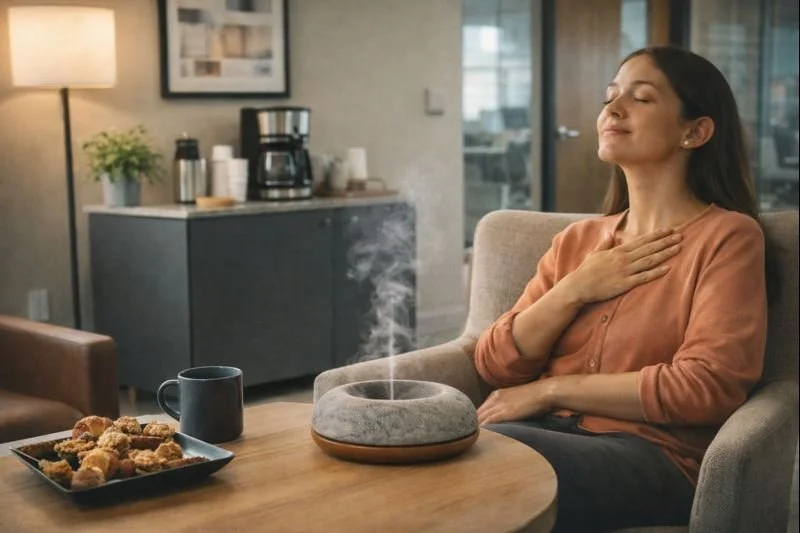
Forest-bathing aromatics should be used personally, never diffused into shared airspaces. Appropriate formats include:
Rollerball use
Diffusers placed in a quiet, reflective space
Scent cards stored in a drawer or bag
This preserves choice, respects sensitivities, and aligns with trauma-informed principles.
2. Brief, Intentional Exposure
Slow and targeted diffusion or rollerball application is sufficient. The goal is not prolonged exposure, but a clear sensory cue that signals the nervous system to slow and orient toward safety.
More scent does not increase effectiveness. Consistency matters more than strength.
3. Pair With a Regulating Action
Aromatics are most effective when paired with another regulating behavior, such as:
Slow nasal breathing (4–6 second exhale)
Gentle posture adjustment or grounding through the feet
A brief pause with eyes softly focused or closed
This pairing helps the body associate the aroma with settling rather than alertness.
Structuring a Personal Forest-Bathing Ritual at Work
A workplace-appropriate forest-bathing ritual should be:
Predictable
Time-limited (30–90 seconds)
Free of performance expectations
Example structure:
Step away from the screen or task
Close your eyes and focus on the aroma coming from your diffuser.
Notice physical sensations (temperature, contact with chair or floor)
Resume work intentionally
This is not meditation and does not require emotional reflection. It is a physiological reset, not a cognitive exercise.
When to Use Nature-Inspired Aromatics at Work
Forest-bathing aromatics are particularly well suited for:
Transitions between meetings
After difficult conversations
During recovery breaks
At the end of the workday to signal closure
They are not intended for use during active collaboration, meetings, or times requiring heightened alertness.
Why This Approach Works
Nature-inspired sensory cues operate through the limbic system, which governs emotion, memory, and survival responses. When the nervous system receives signals associated with non-threatening environments — such as earthy, grounded aromas — it becomes easier to shift out of chronic vigilance.
Over time, repeated low-intensity exposure paired with regulation can help:
Reduce stress reactivity
Improve emotional steadiness
Support clearer cognitive functioning
Reinforce recovery habits
This is particularly relevant in professions characterized by constant decision-making, emotional labor, or crisis exposure.
A Sensory Regulation Framework
In my work, I use a simple, trauma-informed framework for sensory regulation:
Notice - Track physical sensations without judgment — changes in breath, muscle tone, temperature, or heart rate.
Orient - Reconnect with the present moment by feeling the surface beneath you, noticing your surroundings, or naming - where you are.
Engage the Senses - Introduce supportive sensory input intentionally and lightly. Apply aromatics to pulse points, pair with slow breathing, and allow the sensation to feel inviting rather than overwhelming.
Allow the Shift - Let the nervous system move gradually — fear may soften into curiosity, curiosity into steadiness, and steadiness into grounding.
Integrate - When regulation happens during challenge, the nervous system learns resilience and adaptability over time.
Important Boundaries
Aromatherapy and sensory practices are not substitutes for medical or mental health care. Individual responses vary, and practices should always be adapted with consent, sensitivity, and respect for personal history — particularly for those with trauma or sensory sensitivities. Key ethical boundaries for workplace use include:
Use must always be voluntary.
No claims of treatment or cure should be made.
Aromatherapy must complement — not replace — medical or mental-health care.
Sensory practices should never be used to override fatigue or distress.
Forest-bathing aromatics are not tools for pushing through stress. They are tools for recognizing when the body needs to slow.
Final Thoughts
Forest bathing in the workplace is not about recreating nature — it is about restoring regulation. When nature-inspired aromatics are used gently, personally, and with intention, they can provide meaningful nervous-system support in environments that demand constant engagement.
Shinrin-yoku — whether experienced directly in nature, supported through diffusion or, as with me just prior to a medical procedure, quickly through application by a roller ball — reminds the body of its innate capacity to settle, adapt, and endure. When the nervous system feels safe enough, resilience naturally follows.
Learn more about aromatherapy and the uses and benefits of essential oils at Florida Oils Rn.
**********************
References
Antonelli, M., Barbieri, G., & Donelli, D. (2022). Effects of forest bathing (shinrin-yoku) on levels of cortisol as a stress biomarker: A systematic review and meta-analysis. International Journal of Biometeorology, 66(1), 1–15. https://pubmed.ncbi.nlm.nih.gov/31001682/
Harvard Health Publishing. (2016). The healing power of nature. Time. https://time.com/collections/guide-to-happiness/4405827/the-healing-power-of-nature/
Li, Q., Kobayashi, M., Wakayama, Y., Inagaki, H., Katsumata, M., Hirata, Y., Hirata, K., Shimizu, T., Kawada, T., Park, B. J., Ohira, T., Kagawa, T., & Miyazaki, Y. (2009). Phytoncides (wood essential oils) induce human natural killer cell activity. Immunology Letters, 123(2), 124–130. https://doi.org/10.1016/j.imlet.2009.02.006
Li, Q. (2010). Effect of forest bathing trips on human immune function. Environmental Health and Preventive Medicine, 15(1), 9–17. https://doi.org/10.1007/s12199-008-0068-3
Li, Q. (2018). Forest bathing: How trees can help you find health and happiness. Penguin Random House UK.
Li, Q. (2022). Effects of forest environment (Shinrin-yoku/Forest bathing) on health promotion and disease prevention — the establishment of “Forest Medicine”. Environmental Health and Preventive Medicine, 27, Article 43. https://doi.org/10.1265/ehpm.22-00160
Park, B. J., Tsunetsugu, Y., Kasetani, T., Kagawa, T., & Miyazaki, Y. (2010). The physiological effects of Shinrin-yoku (taking in the forest atmosphere or forest bathing): Evidence from field experiments in 24 forests across Japan. Environmental Health and Preventive Medicine, 15(1), 18–26. https://doi.org/10.1007/s12199-009-0086-9
Song, C., Ikei, H., & Miyazaki, Y. (2025). Physiological effects of forest environments on human health: A review of field experiments. Forests, 16(2), 310. https://doi.org/10.3390/f16020310
Immune Function / NK Cells: Forest bathing trips have been associated with increased natural killer (NK) cell activity and increased expression of immune-related anti-cancer proteins, with effects lasting days to weeks in some studies. https://pmc.ncbi.nlm.nih.gov/articles/PMC2793341/